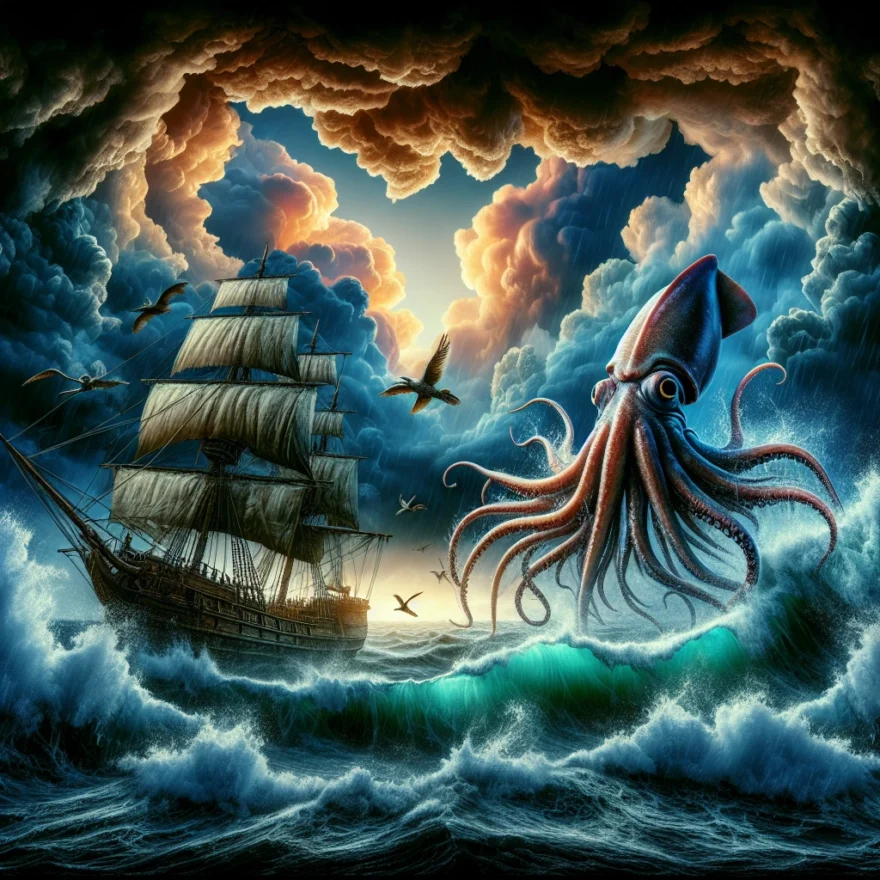
Introduction: The Legend of the Kraken
The Kraken, a creature steeped in mystery and legend, has captivated the imaginations of seafarers and land dwellers alike for centuries. This monstrous entity, said to dwell in the deepest, darkest corners of the ocean, has been a staple of maritime lore, often depicted as a gigantic beast capable of dragging entire ships into the watery abyss.
Originating from Scandinavian folklore, the Kraken was first described in the 13th century Icelandic saga, the Örvar-Oddr. The creature was said to be so large that it was often mistaken for an island, and so powerful that it could create whirlpools capable of pulling a ship to its doom. Over the centuries, the legend of the Kraken has evolved and taken on different forms, but its core characteristics remain the same: a colossal, tentacled creature, lurking in the depths, waiting to unleash its fury on unsuspecting sailors.
Despite its fearsome reputation, the Kraken is not merely a creature of myth and legend. Over the years, numerous sightings and encounters have been reported, sparking debates among researchers, scientists, and enthusiasts. Is the Kraken a real creature, lurking in the unknown depths of our oceans, or is it a figment of our collective imagination, a symbol of the vast and terrifying unknown that the ocean represents? This article delves into the mystery of the Kraken, exploring its historical encounters, its depiction in literature and popular culture, and the scientific theories that may explain its existence.
Table of contents
- Introduction: The Legend of the Kraken
- Historical Encounters with the Kraken
- The Kraken in Literature and Popular Culture
- The Science Behind the Myth: The Giant Squid
- Giant Squid: The Real-Life Kraken
- Comparing the Kraken and the Giant Squid
- The Kraken and the Giant Squid: A Matter of Size
- The Kraken: Fact or Fiction?
- Common Questions about the Kraken and the Giant Squid
- Conclusion: The Kraken and the Giant Squid Unveiled
Historical Encounters with the Kraken
Delving into the annals of maritime history, one finds numerous accounts of encounters with what seafarers believed to be the monstrous Kraken. These tales, passed down through generations, have painted a vivid picture of this terrifying sea creature, its massive tentacles and its penchant for dragging entire ships under the sea.
The earliest mentions of the Kraken date back to the 13th century in Old Norse sagas, where it is described as a sea creature of enormous size that resides off the coasts of Norway and Greenland. The Norse sagas describe the Kraken as a creature so large, it was often mistaken for an island. Sailors not realizing the danger, would anchor their ships to the ‘island’, only to be dragged down to the depths when the Kraken awakened.
In the 18th century, Swedish author Jacob Wallenberg described the Kraken in his work “Min son på galejan” (My son on the galley), as a creature “round, flat, and full of arms,” capable of reaching the tallest ship masts. Around the same time, Erik Pontoppidan, a Danish bishop, wrote extensively about the Kraken in his “Natural History of Norway.” Pontoppidan claimed the beast was “the largest and most surprising of all the animal creation,” and that its enormous tentacles could pull down even the biggest warships.
Despite these terrifying descriptions, not all historical accounts of the Kraken were filled with fear and dread. Some seafarers viewed the creature as a good omen. They believed that a Kraken’s appearance at the surface indicated a great abundance of fish. Fishermen would then rush to the area, willing to risk the danger for the bountiful catch.
While it’s easy to dismiss these accounts as mere sailors’ tales, they have persisted for centuries, keeping the legend of the Kraken alive. Whether these encounters were with a real creature or a figment of seafarers’ imaginations remains a topic of debate and speculation, a mystery as deep and unfathomable as the ocean itself.
The Kraken in Literature and Popular Culture
The Kraken, with its immense size and terrifying power, has captured the imagination of people throughout history, leading to its prominent presence in literature and popular culture. From ancient legends to modern-day novels and films, the Kraken has become an iconic sea monster that continues to fascinate and thrill audiences.
In literature, the Kraken has been depicted as a colossal creature capable of causing destruction on a massive scale. One of the earliest references to the Kraken can be found in “The Natural History” by Pliny the Elder, a Roman author and naturalist who described a creature called the “hafgufa” that resembled an island and could drag down ships with its tentacles.
However, it was in Scandinavian folklore that the Kraken gained its most famous reputation. In Norse mythology, the Kraken was believed to dwell in the seas surrounding Norway and Iceland. It was described as a giant sea monster with multiple arms or tentacles that could easily capsize ships and create whirlpools.
These ancient tales of the Kraken have inspired countless authors and poets over the centuries. In the epic poem “The Odyssey” by Homer, the hero Odysseus encounters the monstrous Scylla, a creature often associated with the Kraken. The Kraken also made appearances in the works of authors such as Jules Verne, H.P. Lovecraft, and Tennyson, further cementing its place in literature.
Popular culture has also embraced the Kraken, featuring it in various forms of entertainment. One of the most notable examples is the Kraken’s appearance in Disney’s “Pirates of the Caribbean” film series. In these movies, the Kraken is portrayed as a massive cephalopod-like creature controlled by the villainous Davy Jones, wreaking havoc on ships and terrorizing sailors.
Video games have also incorporated the Kraken into their narratives. In the popular game “Sea of Thieves,” players can encounter the Kraken while sailing the open seas, engaging in intense battles to survive its deadly attacks. The Kraken’s inclusion in these games adds an element of excitement and danger to the gameplay experience.
Furthermore, the Kraken has become a staple in modern-day art, appearing in paintings, sculptures, and even tattoos. Its monstrous and mysterious nature makes it a captivating subject for artists looking to evoke a sense of awe and wonder.
While the Kraken may have originated as a mythical creature, its presence in literature and popular culture has transformed it into an enduring symbol of power and the unknown. Whether it is portrayed as a fearsome sea monster or a creature of pure fantasy, the Kraken continues to captivate audiences and fuel our imagination.
The Science Behind the Myth: The Giant Squid
The Kraken, a legendary sea monster of enormous size and power, has captivated the imaginations of sailors and storytellers for centuries. But is there any truth behind this mythical creature? To uncover the reality behind the Kraken, we must delve into the science behind the myth and explore the fascinating world of the giant squid.
The giant squid (Architeuthis dux) is a deep-sea dwelling creature that can grow to immense proportions. With eyes the size of dinner plates and tentacles that can reach over 40 feet in length, it is no wonder that the giant squid has been associated with the legendary Kraken.
For centuries, sightings of giant squids were rare, leading to speculation and myth-making about their existence. It wasn’t until the late 19th century that the first tangible evidence of these elusive creatures was discovered. In 1873, a dead giant squid washed ashore in Newfoundland, Canada, providing scientists with the opportunity to study this enigmatic creature up close.
Since then, researchers have made significant strides in understanding the biology and behavior of the giant squid. They have used submersibles and deep-sea cameras to capture footage of these magnificent creatures in their natural habitat. Through these observations, scientists have been able to dispel some of the myths surrounding the Kraken.
One of the most striking features of the giant squid is its size. While not as colossal as the Kraken of legend, the giant squid can still reach lengths of up to 43 feet, including its tentacles. This impressive size, combined with its fearsome appearance, has likely contributed to its association with the mythical sea monster.
The giant squid’s tentacles are lined with suckers, each equipped with a ring of sharp teeth-like structures called “serrations.” These serrations allow the squid to grip onto its prey tightly. It is easy to see how encounters with a giant squid could have been interpreted as attacks by a monstrous creature with immense strength.
Another intriguing aspect of the giant squid is its hunting behavior. These creatures are known to dwell in the deep ocean, often at depths of over 3,000 feet. They use their large eyes to detect prey and their long tentacles to snatch it from the water. The giant squid’s diet primarily consists of fish and other squid, but it has been known to take on larger prey, including small whales.
While the giant squid is a formidable predator in its own right, it lacks the fantastical abilities attributed to the Kraken. There is no evidence to suggest that giant squids can create whirlpools or capsize ships with their sheer size and strength. These exaggerated traits are likely the product of imaginative storytelling and embellishment over time.
So, while the giant squid may not possess all the extraordinary qualities of the Kraken, it is undoubtedly a creature worthy of fascination and awe. Its real-life existence and impressive size make it a captivating subject for scientific study and fuel for the ongoing exploration of the mysteries of the deep sea.
Giant Squid: The Real-Life Kraken
The Giant Squid, also known by its scientific name Architeuthis, is a real-life creature that has often been associated with the legendary Kraken. This deep-sea dwelling cephalopod is one of the largest known invertebrates on Earth and possesses a mysterious and awe-inspiring presence.
The Giant Squid can grow to enormous lengths, with some specimens reaching up to 43 feet in length, although most are typically around 33 feet long. It is characterized by its long, slender body and large, bulbous head, equipped with sharp beak-like jaws and powerful tentacles lined with suckers.
Despite its massive size, the Giant Squid remains elusive and rarely encountered by humans. It resides in the deep ocean, often at depths of over 3,000 feet, making it challenging for scientists to study and observe in its natural habitat.
The first documented encounter with a Giant Squid occurred in 1874 when a dead specimen washed ashore in Newfoundland, Canada. Since then, researchers have made significant progress in understanding these enigmatic creatures through the examination of carcasses, video footage, and even the capture of live individuals.
Scientists believe that the Giant Squid’s colossal size and fearsome appearance have contributed to its association with the mythical Kraken. The Kraken, as described in ancient folklore and seafaring tales, was said to be a gigantic sea monster capable of capsizing ships and devouring entire crews. The similarities between the Kraken and the Giant Squid, particularly their size and tentacled appendages, have led many to draw connections between the two.
However, it is important to note that the Giant Squid is a real creature with biological explanations for its behavior and physiology. It is not a mythical beast with supernatural powers. The Giant Squid primarily feeds on deep-sea fish and other squid species, using its tentacles to capture and subdue its prey.
In recent years, advancements in technology, such as deep-sea exploration vehicles and remotely operated underwater cameras, have allowed scientists to capture incredible footage of live Giant Squids in their natural habitat. These observations have provided valuable insights into their behavior, mating habits, and ecological role within the marine ecosystem.
Despite our increased understanding of the Giant Squid, there is still much to learn about these fascinating creatures. Their elusive nature and deep-sea habitat continue to present challenges to researchers, leaving many aspects of their lives and behaviors shrouded in mystery.
Comparing the Kraken and the Giant Squid
When discussing the Kraken and the Giant Squid, it is important to note that while they are often associated with one another, they are not the same creature. The Kraken is a legendary sea monster from Scandinavian folklore, while the Giant Squid is a real-life cephalopod that inhabits the deep oceans.
One of the main differences between the Kraken and the Giant Squid is their origins. The Kraken is steeped in mythology and has been described as a colossal creature capable of capsizing ships and creating whirlpools. It is often depicted as a massive octopus or squid-like creature with tentacles that can reach extraordinary lengths.
On the other hand, the Giant Squid is a known species of squid that belongs to the genus Architeuthis. While it is indeed a large creature, it does not possess the mythical qualities attributed to the Kraken. The Giant Squid can grow to impressive sizes, with some individuals reaching lengths of up to 43 feet.
In terms of appearance, the Kraken and the Giant Squid share some similarities. Both creatures have long tentacles and a mantle, which is the main body part of a squid. However, the Kraken is often depicted as having multiple heads or a more monstrous appearance, while the Giant Squid has a more streamlined and recognizable squid-like shape.
Another important distinction between the Kraken and the Giant Squid is their existence in reality. While there have been numerous reported sightings and encounters with the Giant Squid, the existence of the Kraken remains purely in the realm of folklore and mythology. The Giant Squid has been documented through scientific research, including the discovery of specimens and the use of deep-sea exploration technology.
It is worth noting that the legends and stories surrounding the Kraken may have been inspired by real-life encounters with the Giant Squid. The sight of a massive squid-like creature emerging from the depths of the ocean could easily fuel tales of a monstrous sea monster capable of wreaking havoc.
In conclusion, while the Kraken and the Giant Squid share certain similarities in appearance, they are fundamentally different entities. The Kraken is a legendary creature from folklore, while the Giant Squid is a real-life species of squid. Understanding this distinction is crucial when examining the accounts and stories surrounding these fascinating creatures.
The Kraken and the Giant Squid: A Matter of Size
One of the key aspects that differentiate the Kraken from the giant squid is their size. The Kraken, as described in folklore and legends, is often depicted as a colossal sea monster capable of engulfing entire ships with its massive tentacles. This portrayal has led to the belief that the Kraken is a creature of enormous proportions.
On the other hand, the giant squid, which is a real-life cephalopod species, also boasts an impressive size. These deep-sea dwellers can grow up to lengths of 43 feet (13 meters) and weigh up to 600 kilograms (1,300 pounds). Their enormous size has made them the subject of fascination and speculation for centuries.
While both the Kraken and the giant squid are undeniably large creatures, there is a notable difference in their reported sizes. The Kraken is often described as being several times larger than even the largest giant squid. According to legends, the Kraken’s massive size allows it to easily overpower and destroy ships, dragging them down into the depths of the ocean.
However, when it comes to scientific evidence, there have been no confirmed sightings or encounters with a creature matching the size of the Kraken. The giant squid, on the other hand, has been extensively studied and documented by scientists. Despite its impressive size, it falls short of the colossal proportions attributed to the Kraken in folklore.
It is important to note that the size of the Kraken described in legends may have been exaggerated over time. Stories of the Kraken were often passed down through oral traditions, leading to embellishments and exaggerations. These exaggerations may have contributed to the belief in a creature of truly gargantuan proportions.
On the other hand, the giant squid’s size has been confirmed through scientific observations and the examination of specimens. While it is not as massive as the Kraken of legend, the giant squid’s size is still awe-inspiring and adds to the mystery and fascination surrounding these deep-sea creatures.
In conclusion, while both the Kraken and the giant squid are large creatures, the reported size of the Kraken exceeds that of the giant squid. The Kraken’s colossal proportions are primarily based on folklore and legends, whereas the giant squid’s size has been scientifically documented. The disparity in reported sizes between the two creatures suggests that the Kraken, as described in folklore, may be more a product of imagination and storytelling than an actual creature that roams the seas.
The Kraken: Fact or Fiction?
The Kraken: Fact or Fiction?
Throughout history, the Kraken has captured the imaginations of sailors, writers, and artists alike. Its monstrous size and fearsome reputation have made it a prominent figure in folklore and mythology. But is the Kraken a real creature or merely a product of human imagination?
While there have been numerous accounts of Kraken encounters, it is important to approach these stories with a critical eye. Many of the historical descriptions of the Kraken were likely exaggerated or embellished over time. Sailors, prone to superstition and eager to share tales of their adventures, may have added fantastical details to their accounts.
However, it is worth noting that some of the reported characteristics of the Kraken align with the behavior of real-life creatures, such as the giant squid. The giant squid is a deep-sea dwelling cephalopod that can grow to enormous sizes, with some individuals reaching lengths of up to 43 feet.
Scientific investigations and the discovery of giant squid specimens have shed light on the potential origins of the Kraken legend. The immense size and elusive nature of the giant squid may have contributed to its association with the mythical sea monster. In fact, it is possible that sightings of giant squids gave rise to the legends of the Kraken.
While the giant squid is a fascinating creature, it is important to note that there is no concrete evidence to support the existence of the Kraken as depicted in folklore. The Kraken, as described in tales, is often portrayed as a colossal creature capable of capsizing ships with its powerful tentacles. Such exaggerated accounts are unlikely to have a basis in reality.
Furthermore, the Kraken’s ability to create whirlpools and control the movements of the ocean is purely a work of fiction. These characteristics are purely fantastical and do not align with the known behavior of any real-life sea creature.
So, while the Kraken may continue to captivate our imaginations and inspire awe, it is ultimately a creature of myth and legend. The giant squid, on the other hand, is a real-life marvel of the deep sea, with its own fascinating characteristics and behaviors.
While the Kraken may remain a fictional creature, its enduring presence in literature and popular culture serves as a testament to the power of storytelling and the human fascination with the mysteries of the sea.
Common Questions about the Kraken and the Giant Squid
As the legends and myths surrounding the Kraken and the reality of the Giant Squid collide, it’s only natural for curious minds to have questions. Here, we will explore some of the common questions that arise when discussing these mysterious creatures.
1. Are the Kraken and the Giant Squid the same thing?
No, the Kraken and the Giant Squid are not the same thing. The Kraken is a legendary sea monster from Norse mythology, often depicted as a giant octopus or squid-like creature. On the other hand, the Giant Squid is a real-life cephalopod that inhabits the deep ocean.
2. How big can the Giant Squid grow?
The Giant Squid is known to be one of the largest invertebrates in the world. They can grow up to a massive size, with females reaching lengths of up to 43 feet (13 meters) and males typically measuring around 33 feet (10 meters). However, there have been reports of even larger specimens, potentially exceeding 60 feet (18 meters) in length.
3. Has anyone ever seen a Kraken?
There have been numerous accounts throughout history of sailors claiming to have encountered the Kraken. However, these stories are often shrouded in mystery and exaggeration, making it difficult to determine their accuracy. It is important to note that the Kraken is primarily a creature of myth and legend.
4. How do we know that Giant Squids exist?
Although the Giant Squid was once considered a mythical creature, evidence of its existence started to surface in the late 19th century. Over the years, there have been various sightings, as well as the recovery of specimens and the examination of their remains. The most significant breakthrough came in 2004 when the first images of a live Giant Squid were captured.
5. Are there any other creatures similar to the Kraken or the Giant Squid?
While the Kraken and the Giant Squid are unique in their own ways, there are other deep-sea creatures that share similarities. For example, the Colossal Squid is another massive cephalopod that rivals the Giant Squid in size. Additionally, there are various species of octopuses and squids that possess extraordinary abilities and adaptations.
6. Could the Kraken or the Giant Squid pose a threat to humans?
Both the Kraken and the Giant Squid have been portrayed as menacing creatures in folklore and popular culture. However, there is no concrete evidence to suggest that they pose a significant threat to humans. In fact, encounters with these creatures are extremely rare, and they generally prefer to dwell in the depths of the ocean.
7. Are there any ongoing research efforts to study the Giant Squid?
Yes, there are ongoing research efforts to study the Giant Squid and unravel its mysteries. Scientists use various methods, such as deep-sea exploration, DNA analysis, and satellite tagging, to gather information about these elusive creatures. These studies help expand our knowledge of deep-sea ecosystems and the behavior of cephalopods.
8. Can the Kraken or the Giant Squid be found in all oceans?
The Giant Squid is believed to have a global distribution and can be found in all oceans, although they are most commonly encountered in deep waters. As for the Kraken, its existence is confined to mythology and folklore, and there is no scientific evidence to suggest that it roams the oceans.
By delving into the common questions surrounding the Kraken and the Giant Squid, we can separate fact from fiction and gain a better understanding of these captivating creatures. While the Kraken remains a creature of legend, the Giant Squid stands as a real-life marvel of the deep sea.
Conclusion: The Kraken and the Giant Squid Unveiled
After exploring the legend of the Kraken, examining historical encounters, delving into its portrayal in literature and popular culture, and uncovering the scientific truth behind the myth, it becomes clear that the Kraken and the giant squid are closely intertwined.
While the Kraken may have originated as a mythical sea monster, it is likely that the tales were inspired by real-life encounters with the giant squid. These enormous creatures, with their massive tentacles and elusive nature, could easily be mistaken for the legendary Kraken.
Throughout history, sailors have reported sightings of massive sea creatures, describing them as monstrous beings capable of capsizing ships. These encounters, combined with the vivid imaginations of storytellers and the desire to explain the unexplainable, gave rise to the legend of the Kraken.
However, as scientific knowledge advanced, the existence of the giant squid was confirmed. These deep-sea dwellers, known for their immense size and elusive nature, matched many of the descriptions attributed to the Kraken. The discovery of giant squid specimens and the advent of underwater photography and videography have provided concrete evidence of their existence.
While the Kraken and the giant squid share many similarities, there are also notable differences between the two. The Kraken, as depicted in folklore, is often described as a colossal creature capable of pulling down entire ships. On the other hand, the giant squid, while impressive in size, does not possess the same level of destructive power.
Size is another differentiating factor between the Kraken and the giant squid. The Kraken is often depicted as a gigantic creature, capable of dwarfing even the largest ships. In contrast, while the giant squid is indeed large, it does not reach the immense proportions attributed to the Kraken in legends.
So, is the Kraken a mere figment of imagination or a real-life creature? While there is no concrete evidence to support the existence of a mythical sea monster like the Kraken, the giant squid serves as a plausible explanation for the tales of monstrous creatures encountered at sea.
In conclusion, the Kraken and the giant squid are intimately connected. The legend of the Kraken likely originated from actual encounters with the giant squid, with the stories growing in embellishment over time. While the Kraken may not be a factual creature, the giant squid’s existence provides a scientific basis for the myth. The line between fact and fiction may blur, but the fascination with these mysterious creatures continues to captivate our imaginations.