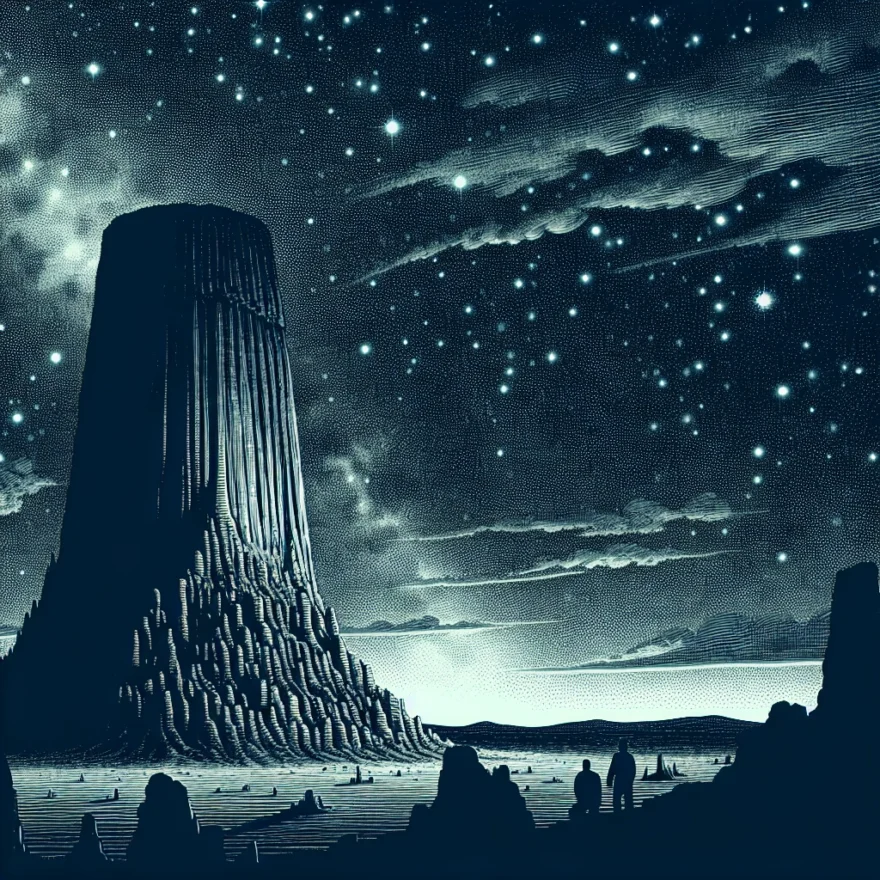
Introduction: The Enigma of the Devil’s Tower
Standing tall and solitary in the midst of the rolling prairie of northeastern Wyoming, the Devil’s Tower is a sight that captivates and mystifies. This geological structure, which rises 867 feet from base to summit, has been a source of wonder and speculation for centuries. Its sheer vertical walls and hexagonal columns of rock are unlike anything else in the surrounding landscape, leading many to question its origins. Is it a natural formation sculpted by the forces of erosion over millions of years, or could it be the remnants of an ancient monument, bearing testament to a civilization long past?
Designated as America’s first National Monument by President Theodore Roosevelt in 1906, the Devil’s Tower is not only a natural wonder but also a cultural treasure. It holds deep spiritual significance for many Native American tribes, who have their own legends and myths about its creation. The name “Devil’s Tower” itself is a mistranslation of the Native American name, which more accurately translates to “Bear’s Lodge.”
Yet, despite its fame and the fascination it inspires, the Devil’s Tower remains shrouded in mystery. Its unique geological structure and the lack of similar formations nearby have puzzled scientists for years. Furthermore, the tower’s cultural significance and its place in Native American lore add another layer of intrigue. Could the stories told by the Native Americans hold clues to the tower’s origin? Or is the answer to be found in the cold, hard facts of geology?
In this article, we delve deep into the enigma of the Devil’s Tower, exploring both the scientific theories and the cultural beliefs surrounding this awe-inspiring formation. We will examine the evidence, sift through the myths, and attempt to unravel the mystery of whether the Devil’s Tower is a natural formation or an ancient monument.
Table of contents
Natural Formation Theory: Geological Perspective
From a geological standpoint, the Devil’s Tower is a fascinating spectacle. It stands as an impressive igneous intrusion, also known as a laccolith, located in the Black Hills near Hulett and Sundance in northeastern Wyoming, above the Belle Fourche River. It rises dramatically 1267 feet above the surrounding terrain and the summit is 5112 feet above sea level.
The Tower is composed primarily of phonolite porphyry, a type of igneous, volcanic rock, and this is where the natural formation theory takes root. Geologists propose that about 50 million years ago, during the Eocene Epoch, molten magma was forced into the sedimentary rocks above it, and solidified before reaching the surface. Over millions of years, erosion stripped away the softer sandstones and shales, exposing the hard, resistant igneous rock formation we see today.
One of the most striking features of the Devil’s Tower is its columnar jointing. The tower is made up of hundreds of hexagonal columns. The scientific explanation for these columns involves a natural process known as columnar jointing. When certain types of lava cool slowly, they contract and create cracks. These cracks then spread out in a hexagonal pattern, creating columns. Over time, the outer layers of these columns can peel off in a process called exfoliation, leading to the slightly curved appearance of the columns in the Devil’s Tower.
While this explanation certainly seems plausible and is widely accepted within the scientific community, it does not explain all the features of the tower. For instance, the top of the tower is flat, which is unusual for a laccolith, and the rocks around the base of the tower are composed of the same material as the tower itself, suggesting they may have fallen from the tower at some point. These anomalies have led some to speculate that there may be more to the story of the Devil’s Tower than simple natural processes.
Ancient Monument Theory: A Cultural Perspective
The Devil’s Tower, with its intriguing structure and mysterious origins, has long captured the imagination of people around the world. While the natural formation theory provides a scientific explanation for its creation, there is another intriguing perspective to consider – the ancient monument theory.
According to this theory, the Devil’s Tower could be more than just a geological wonder; it could be an ancient monument built by an advanced civilization. Proponents of this theory argue that the tower’s symmetrical shape, precise angles, and unique markings are evidence of human intervention.
One of the key arguments supporting the ancient monument theory is the presence of intricate carvings and symbols on the tower’s surface. These carvings, some claim, resemble ancient hieroglyphs or pictographs found in other ancient sites around the world. They suggest that these markings could be a form of communication or a record of significant events.
Additionally, proponents of the ancient monument theory point to the cultural significance of the Devil’s Tower in Native American lore. Many indigenous tribes, including the Lakota Sioux, Cheyenne, and Kiowa, have legends and stories associated with the tower. They believe that it holds spiritual and sacred significance, often considering it as a place of worship or a gateway to the spirit world.
Some researchers argue that the tower’s alignment with celestial events, such as the summer solstice, further supports the ancient monument theory. They suggest that the builders of the tower possessed advanced astronomical knowledge and intentionally aligned it with significant celestial events for ceremonial or ritualistic purposes.
While the ancient monument theory is intriguing, it is important to approach it with a critical mindset. Skeptics argue that the carvings and symbols found on the tower could be the result of natural erosion or random patterns. They also point out that the cultural significance attributed to the tower by Native American tribes could be based on folklore and myth rather than historical facts.
Scientific studies and research have been conducted to investigate the ancient monument theory. However, conclusive evidence that definitively proves or disproves this perspective is yet to be found.
Ultimately, whether the Devil’s Tower is a natural formation or an ancient monument remains an enigma. Both theories provide fascinating insights into the mysteries of this iconic landmark, leaving us to wonder about the secrets it may still hold.
The Devil’s Tower in Native American Lore
The Devil’s Tower, also known as Bear Lodge Butte, holds great significance in Native American lore. For centuries, various tribes have passed down stories and legends about the formation, attributing spiritual and cultural significance to this majestic natural wonder.
According to the Lakota Sioux, the Devil’s Tower is considered a sacred site and holds a prominent place in their creation myth. They believe that long ago, seven young girls were being chased by a giant bear. In their desperation, they climbed onto a rock and prayed to the Great Spirit to save them. Hearing their cries, the Great Spirit made the rock rise towards the sky, out of reach of the bear’s claws. The bear, in its attempt to climb the rock, left deep claw marks on its surface, creating the distinctive vertical columns we see today.
The Cheyenne people also have their own legend surrounding the Devil’s Tower. They believe that a group of girls went out to play and were spotted by a group of giant bears. The girls ran towards the rock and prayed for help. The rock began to rise, carrying the girls to safety. The bears, in their attempt to reach the girls, left deep grooves on the sides of the rock.
These legends not only explain the unique geological features of the Devil’s Tower but also emphasize the spiritual connection between the Native American tribes and the natural world. The tower is considered a place of prayer, vision quests, and other sacred ceremonies.
Many Native American tribes hold annual ceremonies and gatherings at the Devil’s Tower, where they come together to honor their ancestors, seek spiritual guidance, and celebrate their cultural heritage. These events serve as a reminder of the tower’s cultural significance and its enduring role in Native American traditions.
The Devil’s Tower continues to be a symbol of spiritual strength and resilience for Native American communities. It stands as a testament to the deep-rooted connection between the land and its people, bridging the gap between the natural formation theory and the ancient monument theory surrounding this enigmatic wonder.
Scientific Studies and Research on the Devil’s Tower
Throughout the years, numerous scientific studies and research have been conducted to unravel the mysteries surrounding the Devil’s Tower. These investigations have aimed to provide a deeper understanding of its origin, formation, and significance. Let’s explore some of the key scientific findings and research on the Devil’s Tower:
1. Geological Composition
Geologists have extensively studied the rock composition of the Devil’s Tower. It is primarily composed of phonolite porphyry, a type of igneous rock. The unique vertical columns that make up the tower are a result of the cooling and contraction of molten lava over millions of years.
2. Volcanic Origins
Scientific evidence suggests that the Devil’s Tower was formed around 50 million years ago during a volcanic eruption. The magma from the eruption slowly cooled and solidified beneath the Earth’s surface, eventually becoming exposed due to erosion.
3. Erosion and Weathering
The distinctive columnar shape of the Devil’s Tower is a result of erosion and weathering processes. Over time, wind, water, and other natural forces have gradually eroded the surrounding sedimentary rocks, leaving behind the more resistant igneous rock that forms the tower.
4. Lack of Human Manipulation
Extensive research has found no evidence of human manipulation or construction at the Devil’s Tower. The geological features and composition strongly suggest a natural formation rather than an ancient monument created by human hands.
5. Radiometric Dating
Radiometric dating techniques have been employed to determine the age of the Devil’s Tower. By analyzing the decay of radioactive isotopes within the rocks, scientists have estimated its age to be around 50 million years, consistent with its volcanic origins.
6. Tectonic Activity
Researchers have also investigated the role of tectonic activity in the formation of the Devil’s Tower. It is believed that the tower’s vertical columns were created as a result of the uplifting and fracturing of the Earth’s crust in the region.
7. Geological Similarities
Geologists have identified other similar formations around the world, such as the Giant’s Causeway in Northern Ireland and the Organ Pipes National Park in Australia. These formations share similar characteristics with the Devil’s Tower, further supporting the natural formation theory.
Overall, scientific studies and research have consistently pointed towards the Devil’s Tower being a natural formation resulting from volcanic activity and subsequent erosion. While its striking appearance and cultural significance may continue to captivate our imagination, the evidence overwhelmingly supports its classification as a geological wonder rather than an ancient monument.
Frequently Asked Questions about the Devil’s Tower
What is the Devil’s Tower?
The Devil’s Tower is a unique geological formation located in northeastern Wyoming, USA. It is a large igneous intrusion composed of igneous rock columns that rise vertically from the surrounding landscape. The tower stands at an impressive height of 867 feet and has a circumference of about 1.5 miles.
Is the Devil’s Tower a natural formation?
Yes, according to the prevailing scientific consensus, the Devil’s Tower is a natural formation. It is believed to have formed around 50 million years ago during the Eocene epoch. Geologists attribute its formation to the solidification and cooling of molten rock, which then eroded over time, exposing the distinctive columnar structure we see today.
What evidence supports the natural formation theory?
Geologists point to several lines of evidence supporting the natural formation theory of the Devil’s Tower. These include the presence of similar geological formations in other parts of the world, the consistent composition of the rock columns, and the gradual erosion patterns observed in the surrounding area.
Why do some people believe the Devil’s Tower is an ancient monument?
Some proponents of the ancient monument theory argue that the unique shape and symmetry of the Devil’s Tower suggest it was deliberately constructed by an ancient civilization. They point to the precision of the columnar structure and its alignment with celestial events as evidence of human intervention.
What is the Native American connection to the Devil’s Tower?
The Devil’s Tower holds great cultural and spiritual significance for several Native American tribes, including the Lakota, Cheyenne, and Kiowa. It is considered a sacred site and features prominently in their myths, legends, and religious ceremonies. Many tribes believe the tower to be the result of supernatural or spiritual forces.
Have any scientific studies been conducted on the Devil’s Tower?
Yes, numerous scientific studies have been conducted on the Devil’s Tower. These studies have focused on its geological formation, rock composition, and the effects of erosion. While these studies have provided valuable insights into the natural processes that shaped the tower, they have not conclusively resolved the debate between the natural formation and ancient monument theories.
Is the Devil’s Tower open to the public?
Yes, the Devil’s Tower National Monument is open to the public. Visitors can explore the area, hike the trails, and even climb the tower with proper permits. The site offers breathtaking views of the surrounding landscape and provides an opportunity to learn about its geological and cultural significance.
Can the Devil’s Tower be explained by a combination of natural and cultural factors?
It is possible that the Devil’s Tower is a result of both natural geological processes and cultural significance. While the scientific evidence strongly supports its natural formation, the cultural beliefs and spiritual connections of Native American tribes add another layer of complexity to its enigma. The tower’s significance may lie in its dual nature, representing both the wonders of nature and the rich cultural heritage of the indigenous people.