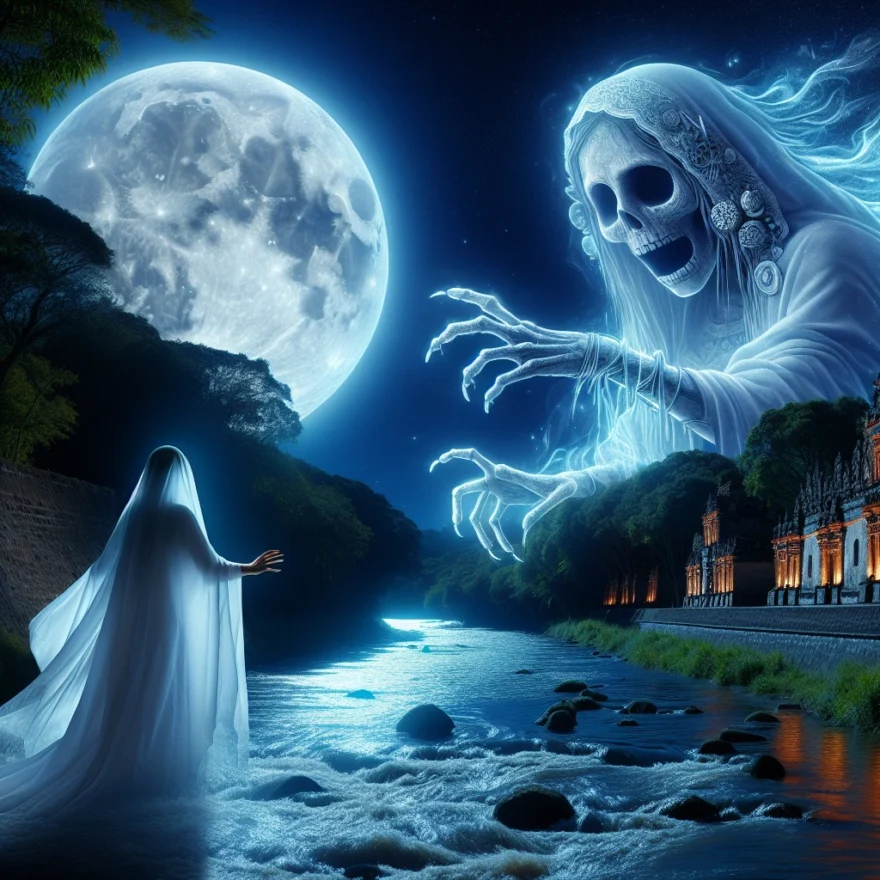
Introduction to the Legend of La Llorona
Her chilling wails echo through the night, a spectral figure dressed in white, forever searching for her lost children along riverbanks and near bodies of water. This is La Llorona, or ‘The Weeping Woman,’ a terrifying figure from Hispanic folklore whose legend has been passed down through generations, from the ancient civilizations of the Aztecs to the present day. The story of La Llorona is deeply ingrained in the cultural fabric of Latin America and has even spread to parts of the United States.
The tale of La Llorona is a tragic one. It tells of a beautiful woman named Maria who drowned her children in a fit of rage after discovering her husband’s infidelity. Overcome with grief and guilt, Maria drowned herself in the same river. However, she was denied entry to the afterlife until she found the souls of her lost children. Thus, she was doomed to wander the earth, wailing in sorrow and searching for her children in the afterlife.
Her ghostly cries of “Mis hijos!” or “My children!” are said to be an omen of death. Those who hear her are advised to run the opposite direction. If they don’t, they risk being dragged into the spirit world by La Llorona herself. The legend serves as a cautionary tale, often used by parents to scare their children into obedience and to keep them away from dangerous waters.
Over the years, the tale of La Llorona has evolved and diversified, taking on different nuances and interpretations depending on the region. Yet, the core of the story remains the same – a restless spirit, a mother’s grief, and the chilling cry that instills fear into the hearts of those who hear it.
But is there more to La Llorona than just an old wives’ tale? Is it possible that this ghostly figure isn’t just a product of folklore, but a real paranormal phenomenon? This article will delve into the legend of La Llorona, exploring its origins, its impact on popular culture, and the numerous eyewitness accounts that suggest that La Llorona might be more than just a scary story.
Table of contents
- Introduction to the Legend of La Llorona
- Origins of the La Llorona Tale
- La Llorona in Popular Culture
- Folklore or Paranormal Phenomenon?
- Eyewitness Accounts and Paranormal Claims
- Psychological Explanations for the La Llorona Phenomenon
- La Llorona and the Supernatural
- Common Questions about La Llorona
- Conclusion: The Enduring Mystery of La Llorona
Origins of the La Llorona Tale
The tale of La Llorona, which translates to “The Weeping Woman,” has its roots deeply planted in the Hispanic folklore, particularly within the Mexican culture. The story, as it is most commonly told, is a heartbreaking and chilling one. It revolves around a beautiful woman named Maria who drowns her children in a river in a fit of rage after discovering her husband’s infidelity. Overwhelmed by guilt and grief, she then drowns herself. However, she is not permitted to enter the afterlife until she finds her drowned children, forcing her to roam the Earth for all eternity, weeping and wailing in her unending search.
While the story’s basic premise remains consistent, the details vary from one version to another. Some narratives paint Maria as a woman of humble origins who marries a rich man, while others describe her as a vain woman who drowns her children because they interfere with her love life. The reasons for her husband’s infidelity also differ between versions. In some, he is drawn away by a younger woman, while in others, he falls out of love with Maria because she has given him children.
The legend of La Llorona has been passed down from generation to generation for centuries. Its origins are difficult to pinpoint, with some scholars tracing it back to an ancient Aztec goddess named Cihuacoatl, who, like La Llorona, is depicted as a wailing woman associated with motherhood and misfortune. Others argue that the story originated during the Spanish Conquest of the Americas, symbolizing the violent clash of cultures and the suffering of the indigenous people.
Over the years, the tale of La Llorona has evolved, adapting to the times and the places where it is told. Despite these changes, the core elements of the story remain the same: a weeping woman, lost children, and a tale of tragedy and remorse that continues to haunt those who hear it.
La Llorona in Popular Culture
Throughout the years, the legend of La Llorona has become deeply ingrained in popular culture, captivating the imaginations of people around the world. This ghostly figure has made appearances in various forms of media, including movies, books, music, and even video games.
One of the most notable portrayals of La Llorona in popular culture is in the 2019 horror film, “The Curse of La Llorona.” Directed by Michael Chaves, the movie tells the story of a social worker who finds herself entangled in the supernatural curse of La Llorona as she tries to protect her own children. The film not only brings the legend to life on the big screen but also introduces it to a wider audience.
Aside from movies, La Llorona has also made her presence felt in literature. Numerous books have been written about her, exploring different aspects of the legend and offering various interpretations. Some authors have delved into the historical origins of the tale, while others have taken creative liberties to reimagine the ghostly figure in modern settings.
Music has also been influenced by the haunting tale of La Llorona. From traditional folk songs to contemporary compositions, her story has been retold through haunting melodies and poignant lyrics. These songs often evoke a sense of sadness and despair, capturing the essence of the legend and the tragedy surrounding it.
Furthermore, La Llorona has made appearances in popular television shows, such as “Supernatural” and “Grimm.” These shows incorporate elements of the legend into their storylines, adding a touch of mystery and supernatural intrigue. The enduring popularity of La Llorona in the realm of television demonstrates the lasting impact of this folklore on modern storytelling.
In recent years, La Llorona has even become a character in video games. She has appeared as a fearsome antagonist, haunting players as they navigate through eerie environments. These interactive experiences allow players to immerse themselves in the legend and confront the ghostly figure firsthand.
The presence of La Llorona in popular culture serves to keep the legend alive and relevant in today’s society. It not only provides entertainment but also sparks curiosity and intrigue, encouraging further exploration of the folklore and its origins.
Folklore or Paranormal Phenomenon?
As the legend of La Llorona has been passed down through generations, it has become deeply ingrained in the folklore of many Latin American cultures. However, the question remains: is La Llorona simply a product of folklore and myth, or is there a possibility that it is rooted in paranormal phenomena?
Many skeptics argue that La Llorona is nothing more than a cautionary tale created to instill fear and discipline in children. They believe that the legend serves as a way for parents to keep their children from wandering off alone, especially near bodies of water. According to this perspective, the ghostly figure of La Llorona is merely a fictional character used to teach important life lessons.
On the other hand, there are those who firmly believe that La Llorona is a genuine paranormal phenomenon. They argue that the numerous eyewitness accounts and reported encounters cannot be easily dismissed. These individuals claim to have seen or heard the wailing woman in various locations, often near rivers or other bodies of water.
One of the most compelling arguments for the paranormal nature of La Llorona is the consistency of the reported experiences across different cultures and regions. Despite variations in the details of the legend, the core elements remain the same: a woman dressed in white, crying for her lost children. This consistency suggests that there may be some truth behind the legend.
In addition to eyewitness accounts, there have been reports of strange occurrences and unexplained phenomena associated with La Llorona. Some individuals claim to have witnessed objects moving on their own, eerie sounds in the night, and feelings of intense sadness or fear when in the presence of La Llorona. These experiences further fuel the belief that there is more to the legend than just folklore.
While skeptics may argue that these paranormal claims can be attributed to psychological factors or mass hysteria, it is important to consider the cultural significance of La Llorona. The legend has been deeply woven into the fabric of many societies, and its impact on individuals cannot be easily dismissed. The power of belief and the collective consciousness of a community should not be underestimated when examining the paranormal aspects of La Llorona.
Ultimately, whether one believes La Llorona is a folklore or a paranormal phenomenon is a matter of personal interpretation. The legend has captivated the imaginations of people for centuries, and its enduring popularity speaks to its cultural significance. Regardless of the explanation, the ghostly legend of La Llorona continues to be a source of intrigue and mystery, leaving us to ponder the unknown.
Eyewitness Accounts and Paranormal Claims
The legend of La Llorona has captivated the imaginations of people for centuries, with numerous eyewitness accounts and claims of paranormal encounters adding to its mystique. While some dismiss these stories as mere folklore, others believe that there may be a supernatural element at play.
One of the most compelling aspects of the La Llorona legend is the sheer number of eyewitness accounts that have been reported over the years. Many individuals claim to have seen or heard the ghostly figure of a woman dressed in white, weeping and wailing along riverbanks or near bodies of water. These sightings often occur at night, adding to the eerie nature of the encounters.
Some witnesses have reported feeling an overwhelming sense of sadness or fear when in the presence of La Llorona. They describe her as having a ghostly appearance, with long, flowing hair and empty, hollow eyes that seem to pierce through one’s soul. Others claim to have heard her haunting cries, which are said to be filled with anguish and despair.
Paranormal investigators and enthusiasts have also delved into the phenomenon surrounding La Llorona. Many have conducted investigations near known hotspots, such as rivers or bridges, in an attempt to capture evidence of her existence. Some claim to have recorded eerie sounds or captured unexplained anomalies in photographs or videos.
While skeptics argue that these accounts can be attributed to hoaxes, hallucinations, or overactive imaginations, others believe that there may be a genuine paranormal element to the La Llorona phenomenon. They point to the consistency of the descriptions and the emotional impact experienced by witnesses as evidence of something beyond mere folklore.
Furthermore, the fact that the La Llorona legend spans across different cultures and regions adds to the intrigue. Similar stories of a weeping woman who drowned her children can be found in various parts of the world, suggesting that there may be some universal element or archetype at play.
It is important to note that the existence of La Llorona as a paranormal entity cannot be proven or disproven definitively. The nature of the supernatural is inherently elusive, and personal experiences vary greatly. However, the enduring nature of the legend and the countless accounts from individuals who claim to have encountered La Llorona cannot be easily dismissed.
Whether La Llorona is a product of folklore, a psychological manifestation, or a genuine paranormal phenomenon, the impact of her legend on cultures and individuals is undeniable. The enduring mystery and fascination surrounding La Llorona ensure that her story will continue to be told for generations to come.
Psychological Explanations for the La Llorona Phenomenon
Throughout history, the legend of La Llorona has captivated the minds of people, leaving them to wonder about the origins and the paranormal nature of this haunting tale. However, some experts believe that there may be psychological explanations behind the La Llorona phenomenon.
One psychological explanation for the legend of La Llorona is the concept of collective fear. Collective fear refers to the shared fears and anxieties that are passed down through generations within a specific culture or community. The fear of La Llorona may have originated as a cautionary tale to keep children away from dangerous places such as rivers or lakes. This fear would have been passed down from parents to children, creating a collective belief in the existence of La Llorona.
Another psychological explanation for the La Llorona phenomenon is the power of suggestion. Suggestion is a powerful tool that can influence our perceptions and beliefs. In the case of La Llorona, stories and accounts of encounters with the ghostly figure may have influenced people to believe in her existence. This can be seen in the way that the legend has spread throughout various communities and cultures, with each group adding their own unique details to the story.
Fear and the human imagination also play a significant role in the La Llorona phenomenon. The fear of the unknown and the fear of death are deeply ingrained in human psychology. The La Llorona legend taps into these fears, creating a sense of unease and fascination. The human mind has a tendency to fill in gaps in information with its own interpretations, and this can lead to the creation of supernatural explanations for unexplained events.
Furthermore, the psychological phenomenon of pareidolia may also contribute to the belief in La Llorona. Pareidolia is the tendency to perceive meaningful patterns or images in random stimuli. This can manifest as seeing faces in clouds or hearing voices in white noise. In the case of La Llorona, people may interpret ordinary sounds or sightings as evidence of her presence, attributing them to the ghostly figure.
It is important to note that psychological explanations do not discount the genuine experiences and beliefs of those who claim to have encountered La Llorona. Rather, they provide alternative perspectives to understand the phenomenon. Whether La Llorona is purely a psychological construct or a paranormal entity remains a subject of debate and personal interpretation.
La Llorona and the Supernatural
Throughout the years, the legend of La Llorona has been associated with various supernatural elements, leading many to question whether there is more to this tale than just folklore. While some believe that La Llorona is purely a product of imagination and storytelling, others argue that there may be a paranormal aspect to the legend.
One of the supernatural elements often attributed to La Llorona is her ability to appear and disappear mysteriously. Numerous eyewitness accounts describe seeing a ghostly figure dressed in white, weeping by the riverside or wandering through the streets at night. These sightings have been reported in different locations, spanning across generations and cultures, which adds to the intrigue surrounding La Llorona.
Additionally, some people claim to have heard the chilling cries of La Llorona echoing through the night. These cries are said to be haunting and otherworldly, sending shivers down the spines of those who hear them. These auditory experiences have been reported in various regions, further fueling the belief in the supernatural nature of La Llorona.
Furthermore, there have been instances where individuals have encountered paranormal activities associated with La Llorona. Some claim to have witnessed objects moving on their own, doors slamming shut, or feeling a presence in their homes after hearing or seeing La Llorona. These alleged paranormal occurrences have led some to believe that La Llorona may be more than just a legend.
While skeptics argue that these experiences can be attributed to psychological factors or mere coincidence, believers in the supernatural argue that there is a deeper, more mystical explanation. They suggest that La Llorona could be a restless spirit, trapped between the realms of the living and the dead, forever searching for her lost children.
It is important to note that the supernatural aspect of La Llorona is largely based on personal accounts and anecdotes. As with any paranormal phenomenon, there is a level of subjectivity and interpretation involved. While some may dismiss these claims as mere superstition, others find solace in the idea that there is more to the legend of La Llorona than meets the eye.
Ultimately, whether La Llorona is a folklore or a paranormal phenomenon is a matter of belief and personal experience. While there is no concrete evidence to prove or disprove the existence of the supernatural in this legend, the enduring fascination and the numerous accounts of encounters continue to keep the mystery alive.
Common Questions about La Llorona
As the legend of La Llorona continues to captivate audiences around the world, it’s natural for people to have questions about this haunting tale. Here are some common questions that often arise:
1. Is La Llorona a real person?
The origins of La Llorona are shrouded in mystery, making it difficult to determine if she was a real person or simply a fictional character created to explain certain phenomena. While some claim to have encountered her, there is no concrete evidence to support the existence of a specific individual named La Llorona.
2. Why is La Llorona often depicted as a weeping woman?
In the legend, La Llorona is said to have drowned her own children and is now condemned to wander, weeping and searching for them. This depiction emphasizes the tragedy and remorse associated with her actions, adding to the eerie nature of the story.
3. Does every culture have a similar legend to La Llorona?
While there are variations of the weeping woman legend in different cultures, La Llorona is most commonly associated with Mexican folklore. Similar tales can be found in other Latin American countries, such as Guatemala and Honduras, but the details and names may differ.
4. Are there any reported sightings of La Llorona?
Over the years, there have been numerous claims of sightings and encounters with La Llorona. These accounts often describe a ghostly figure dressed in white, wailing and searching for her lost children near bodies of water. However, it is important to approach these stories with skepticism, as they are largely anecdotal and lack substantial evidence.
5. Can La Llorona harm people?
According to folklore, La Llorona is known to be a vengeful spirit who can bring misfortune or even death to those who encounter her. However, there is no scientific evidence to support the existence of supernatural entities capable of causing harm. It is likely that the fear associated with La Llorona stems from the power of the legend itself rather than any tangible threat.
6. Why is the legend of La Llorona so enduring?
The legend of La Llorona has persisted for centuries, captivating generations of storytellers and listeners alike. Its enduring popularity can be attributed to its powerful themes of guilt, loss, and the consequences of one’s actions. Additionally, the ghostly nature of La Llorona adds an element of mystery and intrigue that continues to fascinate people to this day.
7. How has La Llorona influenced popular culture?
La Llorona has made her mark on various forms of media, including literature, film, and music. Countless books and movies have been inspired by her story, each offering their own interpretation of the legend. This widespread influence has helped to solidify La Llorona’s place in popular culture.
8. Can the legend of La Llorona be explained by science?
While the legend of La Llorona is deeply rooted in folklore and the supernatural, some researchers suggest that psychological and sociocultural factors may offer explanations for the phenomenon. These theories explore concepts such as collective memory, cultural anxieties, and the power of storytelling in shaping beliefs and experiences.
9. Is there a moral lesson behind the legend of La Llorona?
The legend of La Llorona serves as a cautionary tale, warning against the consequences of one’s actions and the destructive power of unchecked emotions. It reminds us of the importance of empathy, responsibility, and the need to confront our past mistakes.
10. Will the mystery of La Llorona ever be solved?
Given the elusive nature of folklore and the supernatural, it is unlikely that we will ever uncover definitive proof of La Llorona’s existence or unravel the full extent of her legend. However, the enduring fascination with this ghostly figure ensures that the mystery will continue to captivate and intrigue generations to come.
Conclusion: The Enduring Mystery of La Llorona
Throughout the centuries, the ghostly legend of La Llorona has captivated the imaginations of people around the world. Whether it is a tale passed down through generations or a paranormal phenomenon experienced firsthand, the enduring mystery of La Llorona continues to intrigue and fascinate both believers and skeptics alike.
From its ancient origins to its modern-day presence in popular culture, the legend of La Llorona has taken on various forms and interpretations. This ethereal figure has been depicted in countless books, movies, and artworks, solidifying her status as a cultural icon. But the question remains: is La Llorona simply a folklore legend or a genuine paranormal phenomenon?
While skeptics argue that La Llorona is nothing more than a fictional tale created to scare children into behaving, there are numerous eyewitness accounts and paranormal claims that suggest otherwise. People from different cultures and backgrounds have reported encounters with a weeping woman in white, describing her eerie presence and mournful cries. These accounts cannot be easily dismissed as mere fiction.
Psychological explanations also offer insight into the La Llorona phenomenon. The story of a grieving mother who drowned her children and now roams the earth in eternal sorrow taps into deep-seated fears and emotions. It serves as a cautionary tale, reminding us of the consequences of our actions and the importance of parental love and responsibility.
However, there are those who believe that La Llorona’s existence goes beyond the realm of psychology. The supernatural element of the legend suggests a connection to the spirit world, with some claiming that they have witnessed paranormal activity associated with La Llorona. These encounters include unexplained sounds, apparitions, and even physical manifestations.
As with any unexplained mystery, there are countless questions surrounding La Llorona. Is she a vengeful spirit seeking redemption? Or is she a figment of our collective imagination, born out of cultural fears and anxieties? The answers may never be fully known, adding to the allure and intrigue of the legend.
Regardless of whether one believes in the supernatural or dismisses it as folklore, the enduring presence of La Llorona in our cultural consciousness cannot be denied. She continues to be a source of fascination and fear, reminding us of the power of storytelling and the enduring impact of legends.
In conclusion, the ghostly legend of La Llorona remains an enduring mystery. Whether rooted in folklore or paranormal phenomenon, her presence in our collective imagination speaks to something deeper within us. The tales of La Llorona serve as cautionary reminders, exploring themes of loss, grief, and the consequences of our actions. Whether true or not, the legend of La Llorona will continue to haunt our imaginations for generations to come.