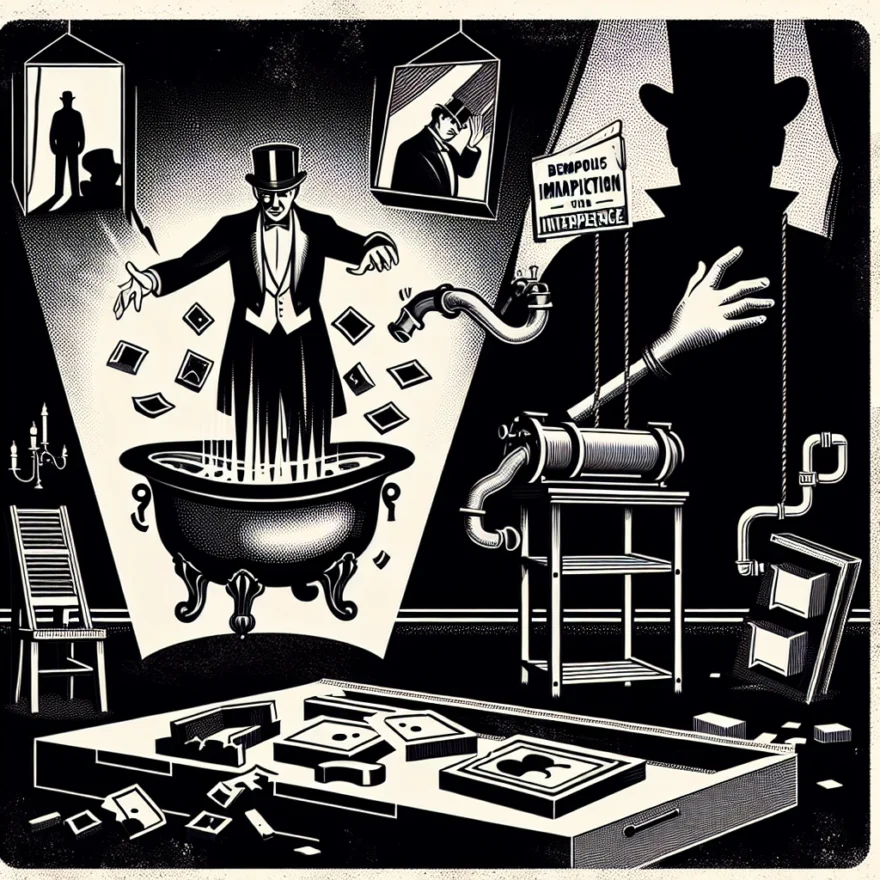
Introduction: The Death of Houdini
Harry Houdini, born Erik Weisz, was a name that echoed through the annals of time, synonymous with the world of magic and illusion. Known for his daring escapes and astounding tricks, Houdini captivated audiences worldwide, pushing the boundaries of what was considered possible. However, his death on October 31, 1926, has been shrouded in a cloud of mystery and intrigue, as enigmatic as the man himself.
It was a death that many found hard to accept, especially given the circumstances. How could a man who had cheated death so many times on stage, succumb to it so suddenly and unexpectedly? The official cause of death was peritonitis secondary to a ruptured appendix, but many have questioned this explanation, suggesting a more sinister cause. Did Houdini, the master escape artist, meet his end through a tragic accident, or was there a more malicious hand at play?
The controversy surrounding Houdini’s death stems from a series of strange events leading up to his demise. These included an unexpected blow to his abdomen, delayed medical treatment, and a contentious relationship with the spiritualist community. These factors have led to numerous conspiracy theories, with some going as far as to suggest that Houdini was murdered.
This article delves into the suspicious circumstances surrounding Houdini’s death, exploring the various theories and evidence that have surfaced over the years. We will examine the events of his last performance, the unexpected blow that supposedly led to his death, the allegations of murder, and the potential involvement of spiritualists. We will also discuss the possibility of medical negligence and the subsequent inquest into his death. Finally, we will address some of the common questions that continue to linger about Houdini’s mysterious demise.
Table of contents
Houdini’s Last Performance
On October 24, 1926, Harry Houdini took the stage for what would be his final performance at the Garrick Theatre in Detroit. Despite suffering from a fever and acute abdominal pain, the world-renowned escape artist, magician, and stunt performer refused to disappoint his fans. Little did the audience know that they were witnessing the last act of one of the greatest illusionists in history.
The performance was remarkable, given Houdini’s physical condition. He had been suffering from appendicitis for several days, but, in classic Houdini fashion, he chose to push through the pain. He was a showman to the end, his dedication to his craft unwavering even in the face of serious illness. Houdini’s wife, Bess, later recounted that he had been in such pain that he needed assistance to lace up his boots before the performance. Yet, once on stage, he seemed to transcend his physical discomfort, delivering a performance that was both mesmerizing and deeply moving.
After the show, Houdini was rushed to the hospital where his condition rapidly deteriorated. His appendix had ruptured, resulting in peritonitis. Despite undergoing two surgeries, Houdini succumbed to his illness on October 31, 1926, on Halloween, a day forever marked by his death.
Many questions surround Houdini’s final performance. Why did he choose to perform despite his severe illness? Could his death have been prevented if he had sought medical attention sooner? Or were there other, more sinister forces at play that contributed to his untimely death? These questions have fueled speculation and controversy for nearly a century, turning Houdini’s death into one of the most enduring mysteries in the history of magic.
The Unexpected Blow
As the world-renowned magician and escape artist, Harry Houdini, took to the stage on October 22, 1926, little did he know that it would be his final performance. The unexpected blow that would ultimately lead to his death was about to take place.
Houdini was known for his daring stunts and his ability to escape from seemingly impossible situations. On that fateful day, he had just completed a series of performances in Montreal, Canada, and was preparing for his next show in Detroit, Michigan.
After his last performance in Montreal, Houdini was approached by a college student named Jocelyn Gordon Whitehead. Whitehead was an amateur boxer and claimed to have strong abdominal muscles. He asked Houdini if it was true that he could withstand any blow to the stomach, as Houdini had previously boasted about his physical endurance.
Without hesitation, Houdini agreed to the challenge. However, what he didn’t know was that Whitehead was not just any college student. He was a strong and skilled boxer who had a personal vendetta against Houdini.
On October 22, Whitehead visited Houdini backstage before the show. Houdini, still wearing his dressing gown, was caught off guard when Whitehead delivered several powerful blows to his abdomen. The blows were so forceful that Houdini was lifted off the ground and left in excruciating pain.
Despite the intense pain, Houdini went on with his scheduled performance that evening. However, his condition quickly deteriorated. He was rushed to Grace Hospital in Detroit, where he was diagnosed with acute appendicitis and peritonitis.
It is widely believed that the blows delivered by Whitehead caused Houdini’s appendix to rupture, leading to the life-threatening condition. The fact that Houdini continued to perform after the incident likely worsened his condition and delayed medical attention.
While some speculate that Whitehead’s actions were premeditated and intended to cause Houdini harm, others believe it was a tragic accident. Regardless of intent, the unexpected blow dealt by Whitehead ultimately led to Houdini’s untimely demise.
The events surrounding Houdini’s death sparked a flurry of speculation and controversy. The question of whether it was an accident or murder became a topic of heated debate.
In the following sections, we will explore the various theories surrounding Houdini’s death, including the possible involvement of spiritualists, medical negligence, and the aftermath of the inquest. Through examining these theories, we hope to shed light on the mysterious circumstances surrounding the death of this legendary performer.
Theories of Murder
As news of Houdini’s death spread, speculation surrounding the circumstances began to swirl. Many questioned whether his death was a mere accident or if there was something more sinister at play. Several theories emerged, suggesting that Houdini’s death may have been a result of foul play.
One theory proposed that Houdini was murdered by individuals who were threatened by his relentless exposure of fraudulent spiritualists. Houdini had made it his mission to debunk fake mediums and expose their tricks, which angered many within the spiritualist community. It is believed that these individuals may have sought revenge by orchestrating his demise.
Another theory suggests that Houdini’s death was a result of medical negligence or deliberate delay in providing him with the necessary medical attention. After the unexpected blow to his abdomen, Houdini continued to perform for several days before seeking medical help. Some speculate that his condition worsened during this time due to a lack of proper medical care, possibly indicating foul play.
The possibility of an intentional poisoning was also raised. It was known that Houdini had received numerous death threats throughout his career, and it is conceivable that someone may have attempted to carry out one of these threats. Poisoning would have been a discreet method of eliminating him without raising immediate suspicion.
Despite these theories, no concrete evidence of foul play has ever been found. The official cause of Houdini’s death was listed as peritonitis resulting from a ruptured appendix, which was consistent with the blow he received during his performance. The inquest into his death concluded that it was an accident.
However, the lingering doubts and unanswered questions surrounding Houdini’s death continue to fuel speculation. The mystery surrounding his demise has become an integral part of his legacy, adding to the intrigue and fascination that still surrounds his name.
The Spiritualist Connection
As the investigation into Houdini’s death unfolded, one theory emerged that suggested a sinister connection between the famous magician’s demise and the world of spiritualism. Spiritualism was a popular belief system during the early 20th century, centered around the idea that the living could communicate with the spirits of the dead.
It is important to note that Houdini was a known skeptic of spiritualism and had actively debunked fraudulent mediums and psychics throughout his career. This led some to speculate that his death may have been orchestrated by spiritualists seeking revenge.
According to this theory, a group of spiritualists, angry at Houdini’s efforts to expose their fraudulent practices, conspired to harm him. They allegedly sought the assistance of a skilled medium who possessed the ability to manipulate Houdini’s weakened state during the performance.
Supporters of this theory point to the fact that Houdini’s sudden illness occurred shortly after he received a blow to the abdomen, which was believed to have been orchestrated by one of the spiritualists. They argue that the blow may have caused internal injuries or exacerbated an existing condition, leading to his untimely death.
However, it is important to approach this theory with caution. While it is true that Houdini’s skepticism of spiritualism made him a target for some practitioners, there is limited concrete evidence to support the claim that spiritualists were directly involved in his death.
Furthermore, the official cause of Houdini’s death, as determined by the medical examiner, was peritonitis resulting from a ruptured appendix. This medical explanation aligns with the initial diagnosis made by the attending physicians. It is worth noting that peritonitis can develop rapidly and lead to a life-threatening condition if left untreated.
Despite the lack of substantial evidence linking spiritualists to Houdini’s death, the theory persists due to the intrigue surrounding the magician’s life and the controversy surrounding spiritualism at the time. The notion of a revenge plot orchestrated by spiritualists adds a layer of mystery to the already puzzling circumstances surrounding his demise.
Ultimately, whether the spiritualist connection played a role in Houdini’s death remains a subject of speculation and debate. While it adds an intriguing element to the narrative, conclusive evidence to support this theory has yet to be uncovered.
Medical Negligence or Deliberate Delay?
One of the theories surrounding the suspicious circumstances of Houdini’s death is the possibility of medical negligence or deliberate delay in providing him with proper medical attention. This theory suggests that there may have been individuals who intentionally hindered Houdini from receiving timely medical treatment, possibly leading to his demise.
Following the unexpected blow to his abdomen, Houdini continued to perform for several days before seeking medical help. It is believed that during this time, his condition worsened due to internal injuries. Some speculate that there may have been a deliberate delay in seeking medical attention, either by Houdini himself or by those around him.
One possible motive for such deliberate delay could be the desire to maintain Houdini’s image as a superhuman performer. Houdini was known for his incredible feats of escape and endurance, and seeking medical help immediately after the incident could have potentially tarnished his reputation. It is possible that Houdini chose to downplay the severity of his condition or that his team advised him against seeking immediate medical attention.
Another theory suggests that there may have been individuals within the spiritualist community who wanted to harm Houdini. As a prominent skeptic and debunker of spiritualist practices, Houdini had made many enemies within the spiritualist community. Some speculate that these individuals may have intentionally delayed his access to medical help, ultimately leading to his death.
However, it is important to note that there is limited concrete evidence to support the theory of medical negligence or deliberate delay. The official cause of Houdini’s death was listed as peritonitis, which is an inflammation of the peritoneum, the lining of the abdominal cavity. This condition can occur as a result of a ruptured appendix or other abdominal injuries.
The inquest into Houdini’s death did not uncover any evidence of foul play or intentional delay in providing medical assistance. The medical professionals who examined Houdini’s body concluded that his condition was likely caused by the blow to his abdomen, and that prompt medical attention may not have saved him due to the severity of his injuries.
While the theory of medical negligence or deliberate delay is intriguing, it remains speculative and lacks substantial evidence. The circumstances surrounding Houdini’s death are still shrouded in mystery, and the true cause of his demise may never be definitively known.
The Inquest and Aftermath
After Houdini’s death, an inquest was held to determine the exact cause of his demise. The inquest took place on October 31, 1926, and was presided over by Coroner Charles F. Murphy.
The witnesses called to testify included members of Houdini’s team, medical professionals, and individuals who were present at the time of the incident. The purpose of the inquest was to gather evidence and determine whether foul play was involved in Houdini’s death.
During the proceedings, conflicting testimonies emerged. Some witnesses claimed that Houdini had been in good health prior to the incident, while others suggested that he had been visibly weakened. The medical professionals who examined Houdini’s body also presented different opinions.
Dr. Charles Kennedy, the family physician, stated that Houdini’s death was a result of peritonitis caused by a ruptured appendix. However, Dr. Harlan Tarbell, a magician and medical expert, disagreed with this assessment. He believed that the blows to Houdini’s abdomen had directly caused his death.
The inquest concluded with Coroner Murphy ruling Houdini’s death as accidental. The official cause of death was listed as peritonitis resulting from a ruptured appendix. Despite the conflicting testimonies and theories, no evidence of foul play was found, and the case was closed.
The aftermath of Houdini’s death left a lasting impact on the world of magic and entertainment. Many speculated about the possible involvement of the spiritualist community in his demise, while others mourned the loss of a legendary performer.
Houdini’s wife, Bess, continued to perform in his memory, often incorporating elements of his acts into her own shows. She also held annual séances on the anniversary of his death, hoping to make contact with him beyond the grave.
The mystery surrounding Houdini’s death has persisted over the years, with various theories and speculations continuing to captivate the public’s imagination. Was it a tragic accident resulting from a poorly timed blow, or was there something more sinister at play?
Houdini’s Legacy and the Continuation of the Mystery
After Houdini’s death, his legacy as the greatest magician and escape artist of all time continued to captivate the world. His death under suspicious circumstances only added to the intrigue surrounding his life and work. The mystery of whether his death was an accident or murder has been a topic of fascination for decades.
Houdini’s influence on the world of magic cannot be overstated. His daring stunts and incredible escapes pushed the boundaries of what was thought possible. He inspired countless magicians and performers to push themselves to new heights, both literally and figuratively. Even today, his name is synonymous with magic and illusion.
But it is the circumstances surrounding his death that have kept the mystery alive. The theories of murder, the connection to spiritualism, and the questions of medical negligence have all contributed to the ongoing speculation.
One theory suggests that Houdini’s death was not accidental but a carefully planned murder. Some believe that he was targeted by individuals who were threatened by his exposure of fraudulent spiritualists. Houdini had made it his mission to debunk these charlatans, and it is speculated that one of them may have sought revenge.
Others argue that the medical negligence or deliberate delay in Houdini receiving proper treatment for his injuries played a role in his death. The fact that he continued to perform for several days after the incident, despite being in immense pain, raises questions about the medical attention he received.
The inquest that followed Houdini’s death was inconclusive, leaving the mystery unresolved. However, the speculation and intrigue surrounding his death have only served to fuel the fascination with his life and work.
Houdini’s legacy lives on not only through his iconic performances but also through the continued speculation and theories surrounding his death. The unanswered questions and the mystery surrounding his final days have become a part of his legend.
Despite the passing of time, the circumstances surrounding Houdini’s death continue to captivate researchers, historians, and magic enthusiasts alike. The debate between accident and murder remains unresolved, leaving room for speculation and interpretation.
As we delve deeper into the life and death of Houdini, it becomes clear that the man behind the magic was just as enigmatic as the illusions he created. The suspicious circumstances surrounding his death only add to the allure and mystique of one of history’s greatest performers.
Common Questions and Answers About Houdini’s Death
Throughout the years, the mysterious circumstances surrounding the death of the legendary magician Harry Houdini have sparked numerous questions and debates. Here, we aim to address some of the most common inquiries about Houdini’s untimely demise.
Q: Was Houdini’s death really an accident?
A: The official cause of death was listed as peritonitis resulting from a ruptured appendix, which suggests that it was indeed an accident. However, there are theories suggesting foul play, which we will explore in the following sections.
Q: What happened during Houdini’s last performance?
A: Houdini performed at the Princess Theater in Montreal on October 24, 1926. During his act, a student named J. Gordon Whitehead punched him in the stomach several times without warning, allegedly as a test of Houdini’s claimed ability to withstand blows to the abdomen. This unexpected blow is believed to have contributed to his later illness and death.
Q: Were there any theories of murder surrounding Houdini’s death?
A: Yes, there have been theories suggesting that Houdini was intentionally murdered. Some believe that the Spiritualist community, which Houdini had publicly criticized, may have been involved. Others speculate that his death was orchestrated by enemies from his past.
Q: What is the connection between Houdini’s death and Spiritualism?
A: Houdini was a prominent skeptic of Spiritualism, a movement that claimed to communicate with the dead. He had exposed several fraudulent mediums and psychics, which made him a target for those involved in the Spiritualist community. Some believe that his death was a result of retaliation from within this community.
Q: Was there any evidence of medical negligence or deliberate delay in Houdini’s treatment?
A: While there were claims of medical negligence and deliberate delay in Houdini’s treatment, no concrete evidence has been presented to support these allegations. The medical professionals involved in his case maintained that they followed standard procedures and acted promptly.
Q: What happened during the inquest and what were the outcomes?
A: An inquest was conducted to determine the circumstances surrounding Houdini’s death. The jury concluded that Houdini’s demise was due to a ruptured appendix caused by the blows to his abdomen. No evidence of foul play was presented during the proceedings.
Q: How has Houdini’s death impacted his legacy?
A: Houdini’s death added a layer of intrigue and mystery to his already legendary status. It solidified his reputation as a master escape artist who met an untimely end. The circumstances surrounding his death continue to captivate audiences and keep his legacy alive.
These are just a few of the common questions and answers surrounding the death of Houdini. The exact truth may never be known, but the enigma of his demise remains an integral part of his incredible story.