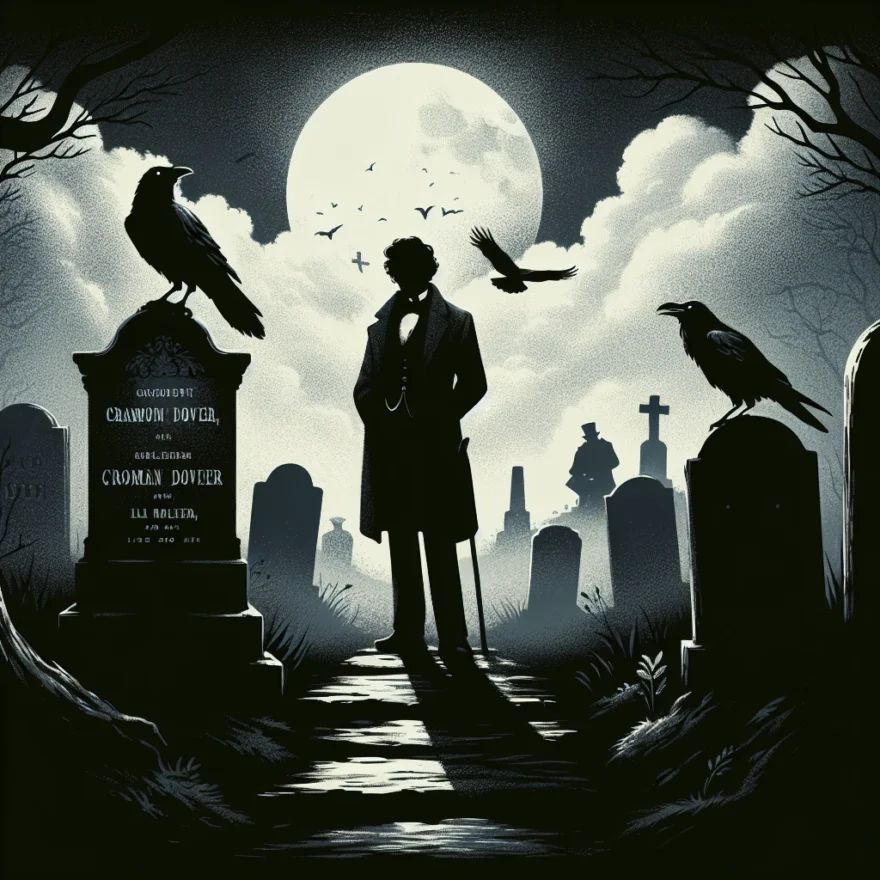
Introduction: The Enigmatic End of Edgar Allan Poe
Edgar Allan Poe, a name synonymous with macabre tales and haunting poetry, left behind a legacy as enigmatic as the stories he penned. His life was a tapestry of tragedy and triumph, love and loss, addiction and recovery. Yet, it is his death that has sparked the most intrigue, stirring up a whirlwind of theories and conjectures that continue to captivate the imagination of literary scholars and mystery enthusiasts alike.
Poe’s death, on October 7, 1849, was as sudden as it was mysterious. He was found in a state of delirium on the streets of Baltimore, wearing clothes that were not his own, and was taken to the Washington College Hospital where he died four days later. The cause of his death was never conclusively determined, giving rise to a plethora of theories that range from the plausible to the outright bizarre.
Despite the passage of over a century and a half, the mystery surrounding Poe’s death remains unsolved, making it one of the most enduring enigmas in literary history. This article delves into the final days of Poe, the various theories surrounding his death, the mysterious ‘Reynolds’ he supposedly called out on his deathbed, and the unopened letter that might have held the key to the riddle of his end. We will also address common questions that readers might have about this fascinating subject.
So, was Poe’s death a tragic end befitting the tortured soul that he was, or was it the result of a sinister conspiracy? Let’s embark on this journey to uncover the truth, or at least, to come as close to it as possible.
Table of contents
- Introduction: The Enigmatic End of Edgar Allan Poe
- The Final Days of Poe: A Timeline
- Theories Surrounding Poe’s Death
- The Cooping Theory: A Sinister Conspiracy?
- Medical Explanations: Illness, Injury, and Addiction
- The Mysterious ‘Reynolds’: A Clue or a Red Herring?
- The Deathbed Scene: Eyewitness Accounts
- The Unopened Letter: A Missed Opportunity?
- The Legacy of Edgar Allan Poe
- Common Questions and Answers about Poe’s Death
The Final Days of Poe: A Timeline
Edgar Allan Poe, a master of macabre literature, met an end as mysterious as his tales. The final days leading to his death on October 7, 1849, are shrouded in mystery, with missing timelines and bizarre circumstances.
On September 27, 1849, Poe left Richmond, Virginia, bound for Philadelphia, where he was to edit a collection of poems for Mrs. St. Leon Loud. However, he never arrived. The next time Poe was seen was on October 3, in a delirious state outside Gunner’s Hall, a public house in Baltimore, where he was found by Joseph W. Walker.
Walker, concerned by Poe’s condition, sought help by sending a letter to Dr. Joseph E. Snodgrass, a friend of Poe. The letter read, “There is a gentleman, rather the worse for wear, at Ryan’s 4th ward polls, who goes under the cognomen of Edgar A. Poe, and who appears in great distress, & he says he is acquainted with you, he is in need of immediate assistance.”
Upon receiving the message, Snodgrass and Poe’s uncle, Henry Herring, rushed to Poe’s aid. They found him in a state of semi-consciousness, wearing clothes that weren’t his, and unable to explain how he came to be in such a state.
From October 3 until his death on October 7, Poe never regained enough consciousness to explain what had happened during the last days of his life. He was taken to Washington College Hospital, where he was attended by Dr. John J. Moran. Despite Moran’s efforts, Poe slipped in and out of consciousness and was unable to provide a coherent explanation of his circumstances.
His final words, according to Moran, were “Lord, help my poor soul.” And with that, one of the most enigmatic figures in American literature passed away, leaving behind a legacy of mystery and a death as puzzling as his tales.
Theories Surrounding Poe’s Death
Edgar Allan Poe’s death has been the subject of much speculation and debate over the years. Numerous theories have emerged, attempting to shed light on the mysterious circumstances surrounding his untimely demise. While some believe that Poe’s death was a tragic end resulting from his struggles with addiction and illness, others propose a more sinister conspiracy behind his demise.
One theory suggests that Poe’s death was not accidental but rather the result of foul play. This theory, known as the cooping theory, suggests that Poe was a victim of a common practice during the 19th century known as “cooping.” Cooping involved kidnapping individuals, forcing them to vote multiple times in different disguises, and subjecting them to physical abuse. Proponents of this theory argue that Poe may have been coerced into participating in cooping, leading to his death.
However, there is limited evidence to support the cooping theory in relation to Poe’s death. The timeline of events leading up to his demise does not align with the typical pattern associated with cooping cases. Additionally, there are no concrete historical records linking Poe to any known cooping activities.
Another line of speculation revolves around Poe’s medical condition. It is well-documented that Poe struggled with alcoholism and substance abuse throughout his life. Some theories suggest that his death was a result of alcohol poisoning or a drug overdose. Others propose that his deteriorating physical and mental health, combined with his addiction, contributed to his demise.
While these medical explanations may provide some insight into the circumstances surrounding Poe’s death, they fail to address the peculiarities of the events leading up to his passing. The presence of delirium and confusion, as reported by witnesses, raises questions about whether there may have been other factors at play.
One intriguing aspect of the mystery is the enigmatic figure known as ‘Reynolds.’ Some believe that ‘Reynolds’ may have been involved in Poe’s death, possibly as a hired assassin or as part of a larger conspiracy. However, the true identity and motives of ‘Reynolds’ remain unknown, leaving this theory shrouded in speculation.
Eyewitness accounts of Poe’s deathbed scene have also fueled speculation. Witnesses reported seeing Poe in a delirious and disheveled state, wearing clothes that were not his own. Some argue that these observations support the theory of foul play, suggesting that Poe may have been drugged or forcibly dressed before his death.
Another puzzling element is the unopened letter found in Poe’s possession at the time of his death. The contents of this letter, which remains a mystery, have led some to believe that it may have held crucial information regarding his demise. However, without knowing the contents of the letter, it is impossible to draw any definitive conclusions.
Ultimately, the true cause of Edgar Allan Poe’s death may never be known with certainty. The various theories surrounding his demise offer intriguing possibilities but lack conclusive evidence. Regardless of the circumstances, Poe’s tragic end has only added to the mystique and legacy of one of literature’s greatest enigmas.
The Cooping Theory: A Sinister Conspiracy?
One of the most intriguing theories surrounding the death of Edgar Allan Poe is the Cooping Theory. This theory suggests that Poe may have fallen victim to a sinister conspiracy known as “cooping.”
Cooping was a common practice during the 19th century, particularly in the political underworld. It involved kidnapping individuals, forcing them to consume large amounts of alcohol or drugs, and then coercing them to vote multiple times under different identities. Cooping victims were often subjected to physical abuse and kept in confinement until they complied.
According to the Cooping Theory, Poe may have been targeted by a group of individuals who wanted to manipulate his vote or silence him due to his outspoken nature and controversial writings. The theory suggests that Poe was kidnapped, drugged, and coerced into voting multiple times during an election day.
Supporters of this theory point to the mysterious circumstances surrounding Poe’s death as evidence. They argue that his disheveled appearance and the fact that he was found wearing clothes that did not belong to him could be attributed to the coercion and confinement he endured while being cooped.
However, it is important to note that the Cooping Theory is highly speculative and lacks concrete evidence. While cooping was a real practice during Poe’s time, there is no direct proof linking it to his death. The theory relies heavily on conjecture and assumptions.
Furthermore, the medical evidence surrounding Poe’s death does not align with the typical outcomes of cooping victims. Poe’s symptoms, such as delirium and hallucinations, are more consistent with alcohol withdrawal or other medical conditions.
Despite the lack of substantial evidence, the Cooping Theory continues to captivate the imaginations of Poe enthusiasts and conspiracy theorists alike. It adds an element of mystery and intrigue to an already enigmatic death.
Ultimately, whether Poe’s death was a tragic end or the result of a sinister conspiracy remains a subject of debate. The Cooping Theory offers a fascinating but unproven explanation that adds to the allure and mystique surrounding the legendary writer’s final days.
Medical Explanations: Illness, Injury, and Addiction
Throughout history, the mysterious death of Edgar Allan Poe has sparked numerous theories and speculations. One of the key aspects surrounding his demise revolves around medical explanations, including illness, injury, and addiction.
It is well-known that Poe struggled with alcoholism throughout his life. This addiction undoubtedly took a toll on his physical and mental health. Heavy drinking can lead to a multitude of health problems, including liver damage, cardiovascular issues, and respiratory complications.
Some theorists argue that Poe’s alcoholism ultimately contributed to his untimely death. They believe that his excessive drinking weakened his body, making him more susceptible to other illnesses and conditions.
However, it is important to note that alcoholism alone may not provide a comprehensive explanation for Poe’s death. Other medical factors could have played a significant role.
One theory suggests that Poe may have suffered from a brain lesion or tumor. Such conditions can cause a range of symptoms, including cognitive impairments, hallucinations, and seizures. These symptoms could explain some of the erratic behavior Poe exhibited in the days leading up to his death.
Moreover, there is evidence to suggest that Poe may have been suffering from other physical ailments, such as tuberculosis or syphilis. Both diseases were prevalent during Poe’s time and could have weakened his immune system, leaving him vulnerable to further complications.
In addition to these medical explanations, there are theories that Poe may have sustained injuries prior to his death. Some speculate that he was the victim of a violent assault, which could have resulted in internal injuries or head trauma.
While these medical explanations provide plausible theories, it is important to acknowledge that there is no definitive evidence to support any one hypothesis. The true cause of Poe’s death remains a mystery, shrouded in speculation and conjecture.
The Mysterious ‘Reynolds’: A Clue or a Red Herring?
One of the most intriguing aspects of Edgar Allan Poe’s death is the mysterious figure known as ‘Reynolds’. Some theorists believe that Reynolds may hold the key to understanding the true circumstances surrounding Poe’s demise, while others dismiss him as a mere red herring. Let’s delve into this enigmatic character and explore the various theories surrounding his involvement.
According to historical accounts, Reynolds was a pseudonym used by Poe during his final days. It is believed that he checked into a tavern under this name shortly before his death. This has led to speculation that Reynolds may have been a co-conspirator in a sinister plot against Poe.
One theory suggests that Reynolds was actually a member of a notorious gang known as the ‘cooping gangs’. These gangs were known for kidnapping unsuspecting individuals, forcing them to consume alcohol and drugs, and then coercing them to vote multiple times in different disguises during elections. The victims would often be subjected to physical abuse, which could explain Poe’s disheveled appearance and the strange circumstances surrounding his death.
Supporters of the cooping theory argue that Poe’s erratic behavior and incoherent state in the days leading up to his death are consistent with the effects of alcohol and drug consumption. They believe that Reynolds, along with the cooping gang, may have targeted Poe as a potential victim due to his vulnerability and reputation as a heavy drinker.
However, not all experts are convinced of the cooping theory. Some argue that there is insufficient evidence to prove that Reynolds was anything more than a pseudonym used by Poe. They suggest that Reynolds may have been a fictional character created by Poe himself as a way to mask his true identity during his final days.
Another theory proposes that Reynolds was actually a close acquaintance or friend of Poe, who may have been present during his final hours. This theory suggests that Reynolds may have witnessed or been involved in the events leading up to Poe’s death but chose to remain silent for unknown reasons.
Despite the lack of concrete evidence, the mystery surrounding Reynolds continues to captivate Poe enthusiasts and researchers alike. The possibility that Reynolds may hold crucial information about Poe’s death adds an intriguing layer to the already puzzling circumstances surrounding the renowned author’s demise.
Ultimately, whether Reynolds is a clue or a red herring remains a subject of debate. Until new evidence emerges or further research sheds light on the matter, the true identity and significance of Reynolds will remain shrouded in uncertainty, adding to the enduring enigma of Edgar Allan Poe’s tragic end.
The Deathbed Scene: Eyewitness Accounts
One of the most intriguing aspects of Edgar Allan Poe’s death is the collection of eyewitness accounts from his deathbed scene. These accounts provide varying perspectives and shed light on the events leading up to his tragic demise.
According to witnesses, Poe was found in a delirious state on the streets of Baltimore on October 3, 1849. He was taken to Washington College Hospital where he remained until his death four days later. During this time, several individuals had the opportunity to observe his condition and interactions.
One of the key witnesses was Dr. John J. Moran, the attending physician at the hospital. Dr. Moran described Poe’s physical state as extremely weak and disheveled. He noted that Poe was in a state of mental confusion and periodically exhibited moments of lucidity. Dr. Moran’s observations suggest that Poe was suffering from a severe illness or intoxication.
Another witness, Joseph W. Walker, a printer who knew Poe, visited him on his deathbed. Walker reported that Poe was incoherent and unable to recognize him. He also mentioned that Poe repeatedly called out the name “Reynolds,” which has sparked much speculation and theories about its significance.
Additionally, a nurse named Mrs. Marie Louise Shew provided her account of Poe’s final days. She described him as being in a state of extreme distress, often crying out and exhibiting signs of agitation. Mrs. Shew also noted that Poe refused to consume any food or drink during his time at the hospital.
These eyewitness accounts paint a picture of a man in great physical and mental anguish during his last days. The conflicting reports and the presence of unusual behavior, such as Poe’s fixation on the name “Reynolds,” have fueled speculation about foul play and conspiracy surrounding his death.
However, it is important to note that the witnesses’ observations were made during a time when medical knowledge and understanding of mental health were limited. The lack of a clear diagnosis and the absence of modern medical equipment make it difficult to definitively determine the exact cause of Poe’s death based solely on these accounts.
Despite the ambiguity surrounding the deathbed scene, the testimonies of those who witnessed Edgar Allan Poe in his final days provide valuable insights into the state of his health and mental well-being. These accounts continue to captivate and intrigue both literary scholars and enthusiasts, adding to the enigma of Poe’s mysterious death.
The Unopened Letter: A Missed Opportunity?
One of the most intriguing aspects of Edgar Allan Poe’s death is the unopened letter that arrived for him shortly before his demise. This unopened letter has sparked much speculation and debate among scholars and enthusiasts alike.
According to historical accounts, a letter addressed to Poe arrived at the office of the Baltimore newspaper where he was found delirious and in distress. It is said that he repeatedly called out the name “Reynolds” during his final hours, and some believe that this unopened letter may hold the key to understanding his mysterious death.
Unfortunately, the content of the letter remains a mystery as it was never opened or read by Poe. Some argue that this unopened letter could have contained vital information or even a warning about impending danger. It is speculated that had Poe been able to read the letter, he may have been able to take actions to protect himself.
However, others believe that the unopened letter may not have been significant at all. It is possible that it was simply a routine correspondence or an unimportant piece of mail. Without knowing the contents of the letter, it is difficult to draw any concrete conclusions.
Despite the uncertainty surrounding the unopened letter, its existence adds an air of mystery to Poe’s death. It leaves us wondering what secrets or revelations may have been contained within its pages.
Some theories suggest that the unopened letter was deliberately withheld from Poe, possibly as part of a sinister plot to harm him. This theory aligns with the idea that Poe’s death was not a mere accident or the result of natural causes, but rather a carefully orchestrated conspiracy.
On the other hand, skeptics argue that the unopened letter may have been a missed opportunity to shed light on the circumstances surrounding Poe’s death. They believe that if the letter had been opened and its contents revealed, it could have provided valuable insights into his final days.
Unfortunately, the truth behind the unopened letter may never be fully uncovered. Its significance will forever remain a subject of speculation and debate, adding to the enigma surrounding Edgar Allan Poe’s tragic end.
The Legacy of Edgar Allan Poe
Edgar Allan Poe, renowned for his macabre tales and haunting poetry, left behind a lasting legacy that continues to captivate readers and inspire writers to this day. While his mysterious death remains a topic of intrigue, it is important to remember the profound impact Poe had on the literary world and beyond.
Poe’s unique style, characterized by his exploration of the dark and psychological depths of the human mind, revolutionized the horror and detective genres. His works, such as “The Tell-Tale Heart,” “The Fall of the House of Usher,” and “The Raven,” are celebrated for their atmospheric descriptions, intricate plots, and unforgettable characters.
Poe’s influence extended far beyond his own lifetime. His innovative storytelling techniques and themes of madness, guilt, and the supernatural paved the way for future generations of writers. Authors like H.P. Lovecraft, Stephen King, and Neil Gaiman have acknowledged Poe’s impact on their own work, paying homage to his legacy through their own dark and imaginative tales.
Furthermore, Poe’s contributions to the development of the detective genre cannot be understated. His creation of the brilliant and eccentric detective, C. Auguste Dupin, served as a precursor to famous literary detectives such as Sherlock Holmes and Hercule Poirot. Poe’s detective stories, including “The Murders in the Rue Morgue” and “The Mystery of Marie Rogêt,” established the foundation for the modern detective story and influenced countless crime writers.
In addition to his literary achievements, Poe’s legacy is also reflected in his impact on popular culture. His iconic poem, “The Raven,” has been referenced and parodied in various forms of media, including films, television shows, and music. The poem’s haunting rhythm and melancholic tone have become synonymous with Poe himself, solidifying his place as a cultural icon.
Moreover, Poe’s enduring reputation as a tortured and enigmatic figure has only added to his mystique. His tragic life, marked by personal struggles, financial hardships, and a constant battle with alcoholism, has made him a symbol of the tormented artist. This image of Poe as a brooding and haunted soul has contributed to his ongoing fascination and the perpetuation of his legend.
While the circumstances surrounding Poe’s death may remain shrouded in uncertainty, his legacy as a literary pioneer and master of the macabre endures. His works continue to captivate readers, his influence reverberates through the annals of literature, and his enigmatic persona continues to fascinate and intrigue. Edgar Allan Poe’s tragic end only serves to further immortalize his name and solidify his place as one of the greatest writers in history.
Common Questions and Answers about Poe’s Death
Common Questions and Answers about Poe’s Death
1. Was Edgar Allan Poe murdered?
While there have been numerous theories suggesting foul play, there is no concrete evidence to support the claim that Poe was murdered. The exact circumstances surrounding his death remain a mystery.
2. What is the Cooping Theory?
The Cooping Theory suggests that Poe may have been a victim of a practice called “cooping,” where individuals were kidnapped, drugged, and forced to vote multiple times in different disguises during elections. It is believed that Poe may have fallen victim to this and suffered from the physical and mental toll it took on him, leading to his demise.
3. Could Poe’s death be attributed to his medical conditions?
Poe had a history of substance abuse, including alcohol and opium. His addiction issues, combined with his fragile physical and mental state, could have contributed to his untimely death. However, the exact role of his medical conditions in his demise remains uncertain.
4. What role did the mysterious ‘Reynolds’ play in Poe’s death?
The identity and significance of ‘Reynolds’ in relation to Poe’s death is still a subject of speculation. Some believe that ‘Reynolds’ was a pseudonym used by Poe himself, while others suggest that it could have been a person involved in his final days. The true nature of ‘Reynolds’ remains elusive.
5. What happened on Poe’s deathbed?
Several eyewitness accounts provide varying details about Poe’s final moments. Some claim he was delirious and incoherent, while others state that he was calm and composed. The conflicting reports have only added to the enigma surrounding his death.
6. Could the unopened letter have held clues to Poe’s death?
Poe received a mysterious letter shortly before his death, which he reportedly never opened. While it is tempting to speculate that the contents of the letter could have shed light on his demise, there is no evidence to support this theory. The letter’s contents remain a mystery.
7. What is Edgar Allan Poe’s legacy?
Poe is widely regarded as one of the greatest American writers, known for his contributions to the genres of horror, mystery, and detective fiction. Despite the uncertainty surrounding his death, his literary works continue to captivate readers and inspire generations of writers.
8. Will we ever know the truth about Poe’s death?
While new theories and speculations may arise, it is unlikely that we will ever have definitive answers regarding the circumstances of Poe’s death. The passage of time and the lack of concrete evidence make it challenging to unravel the truth behind this enduring mystery.